
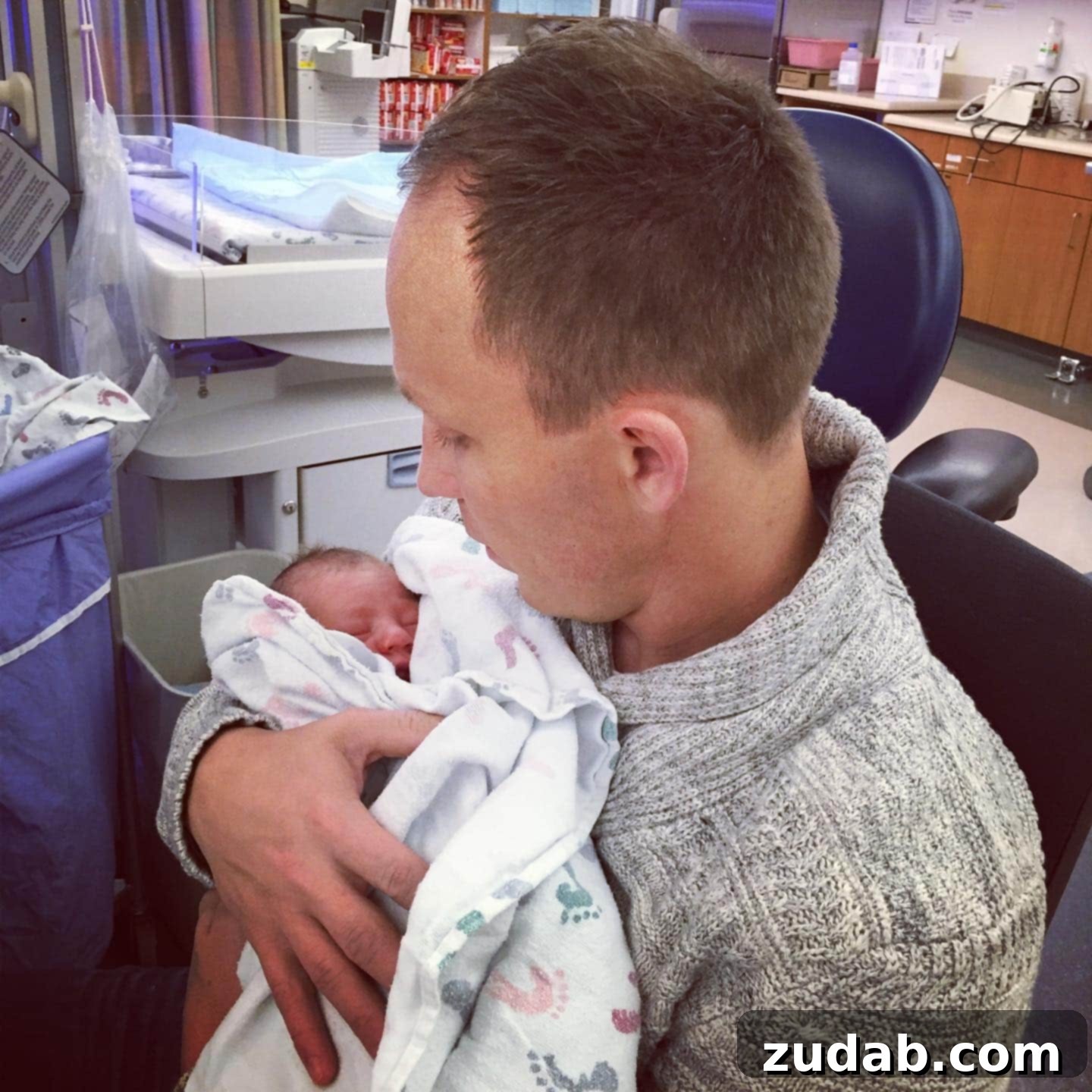
Four pounds. That weight had never felt so monumental until our son arrived. Our older girls were five-pound babies, so the concept wasn’t entirely foreign, yet the reality of Cade snuggling our new, incredibly tiny little guy in the Neonatal Intensive Care Unit (NICU) sent my heart into an accelerated rhythm. He was so small, so perfect, and utterly dependent.
The Unexpected Journey: Welcoming Our Preemie Amidst Life’s Storms
Life has a peculiar way of throwing unexpected challenges our way, often when we least expect them. For our family, the journey took a dramatic turn with the early arrival of our youngest son. What began as a routine hospital stay quickly transformed into an intense immersion into the world of premature birth, a demanding NICU existence, and an unforeseen crisis unfolding simultaneously on the home front. This is our story of fear, fragility, unexpected strength, and the profound lessons learned when a family is truly tested.
A Tiny Arrival: First Moments in the NICU
The moment I was finally able to enter the NICU and saw Cade, my husband, cradling our newborn son, a profound mixture of awe and apprehension washed over me. He was impossibly small, a delicate bundle barely tipping the scales at four pounds. Every curve of his tiny body, every minuscule finger and toe, was a testament to his perfect, albeit premature, formation. He was a miracle, pure and simple, yet his presence in this highly specialized environment underscored the immediate reality of his vulnerability.
The air hummed with the soft, rhythmic beeping of various machines, each monitor displaying vital signs, a constant symphony of medical technology ensuring his well-being. Specialists moved with quiet efficiency, providing updates that were, thankfully, positive. Our little warrior was doing amazingly well; no oxygen assistance was needed, a huge relief. However, the path ahead was clear: a prolonged stay in the NICU was inevitable. This wasn’t just a hospital visit; it was the beginning of an entirely new chapter, one filled with uncertainty and the unwavering hope for our son’s full recovery and safe passage home.
Navigating the Neonatal Intensive Care Unit: A World Apart
Stepping into the NICU was like entering a world entirely separate from the bustling hospital corridors. We were guided into a hushed, closed section, where the lights were significantly dimmed, almost completely off. The low illumination created an atmosphere of quiet introspection, a stark contrast to the bright, sterile environments one might typically associate with medical facilities. We were led to a small, curtained-off area, offering a semblance of privacy. Within this intimate space, a tiny, specialized bed rested under soft lights for the baby, and beside it, a comforting rocking chair awaited a weary mother. This was to be our temporary home, a sanctuary of hope and vigilance.
The first invaluable lesson anyone immersed in the NICU environment quickly learns is the agonizing rhythm of “two steps forward, three steps back.” It’s a relentless, emotional rollercoaster. One day brings joyous news of progress, a milestone achieved, only for the next to introduce an unexpected setback, a minor complication that pulls you back from the brink of hope. This constant ebb and flow of health and emotions demanded an extraordinary level of resilience and an almost Zen-like acceptance of the unpredictable nature of premature development.
The Demands of NICU Motherhood: Pumping and Presence
For a nursing mother, the NICU immediately imposes its own demanding routine. Pumping became an instant, non-negotiable priority. My days dissolved into a relentless cycle: pump, be called to feed him, return to my room, and immediately begin pumping again to establish and build a robust milk supply as quickly as possible. More often than not, by the time I completed a pumping session and nursed our son, nearly three hours would have elapsed. This left me with maybe an hour, if I was lucky, for sleep before the cycle began anew. Exhaustion became a constant companion, a heavy cloak I wore, but the unwavering desire to provide for my baby fueled every effort.
Initially, I managed, benefiting from boarding at the hospital to remain constantly near him. Each day was a crash course in understanding his delicate needs, a rapid education in the nuances of premature infant care. Yet, as the first day drew to a close, a stark realization settled in: this was profoundly different from any “regular” hospital visit I had ever imagined. This was an immersive experience, a journey into the unknown depths of medical care and personal endurance.
Witnessing Other Battles: Empathy in the NICU
The dimmed lights of the NICU revealed a landscape of silent battles. Beside us lay twin babies, across the room another set, and to our left, a tiny fighter. Each was engaged in their own struggle for survival and growth. My heart ached for the family of one set of twins who had already endured two months in the NICU, their parents only able to visit once a day. The limited visitation hours seemed impossibly cruel. I desperately wished that hospital policies allowed volunteers or additional family members to hold those precious babies, to offer the warmth of human touch. Did these infants, so young and vulnerable, truly know where they were? Could they feel the profound sweetness of those fleeting moments when their mother finally arrived to hold them each day?
Cradling our little man, I gently rocked back and forth, a rhythmic motion that was both soothing for him and grounding for me. In my mind, I repeated the tender words of a beloved children’s book: “I’ll love you forever, I’ll like you for always. As long as I’m living my baby you’ll be.” His eyes, so wide and innocent, looked up, locking with mine. He watched silently, patiently. What thoughts might be swirling in his tiny mind if he could speak? Did he know the immense battle I had fought, the arduous journey and prayers, to bring him into this world?
Unraveling the Mystery: A Doctor’s Words and a Mother’s Guilt
Soon, it was time for us to part ways temporarily. Our son needed more tests, and the nurses had to settle him back into his bed. I returned to my room, hoping for a moment of much-needed sleep. But sleep wouldn’t come. A recent conversation with the on-call doctor replayed itself incessantly in my mind, a loop of unsettling yet vital information.
“I would assume your placenta had started to detach, and with him already not growing much and you getting sick again, delivering him early probably saved his life and your own. If you hadn’t delivered early, he wouldn’t be doing well. He needed to be born in order to make it.” These words hung heavy in the air, a complex blend of relief and a lingering, insidious guilt. That darn tree. Weeks prior, I had been involved in removing a stubborn tree. I had taken it easy, or so I thought, but the memory gnawed at me. Heavy lifting, pulling—these actions are known to potentially cause issues in pregnancy. My mind raced, piecing together fragments, wondering if what felt like an inconvenience at the time might have been the very trigger. Could it be that what seemed like a misfortune was, in fact, another profound miracle, albeit one that came with immense challenges?
The Sensory Overload of the NICU
My little wristband, my pass to this cloistered world, granted me entry back into the NICU. I had never experienced anything like it before. The pervasive dimness and quiet were striking, and in that subdued light, each tiny infant in their incubator seemed profoundly alone. This perception, I would soon learn, was far from the truth; a devoted team of caregivers was constantly present, even if their movements were often unseen in the shadows. My son’s little feet were a poked-up mess of bandages and tiny marks from blood draws – a visible testament to the thorough and constant health checks he was undergoing. I was grateful for this meticulous care, even as it underscored his fragility.
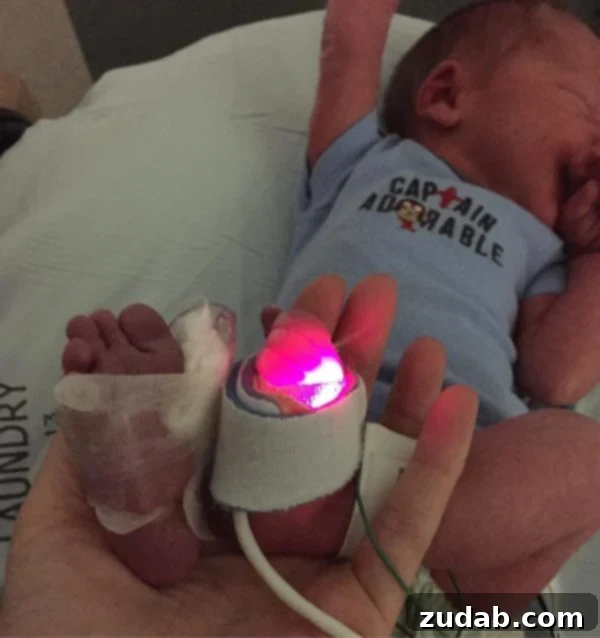
The monitors, with their soft, consistent glowing lights and rhythmic beeps, became the unwavering soundtrack of our stay. These subtle yet persistent pulses were a constant reminder that he wasn’t entirely “out of the woods,” yet they simultaneously conveyed a profound sense of safety and vigilant care, assuring us that every possible measure was being taken to protect him.
When Home Becomes Another Crisis: A Family Under Duress
And then, a new, jarring sound erupted, a sharp contrast to the gentle rhythms of the NICU monitors. It was my mother, calling from our house. The sound jolted me upright from the trance I was in, gently holding our son’s little toes. Something was terribly wrong. It was November, and the house, she reported, was a frigid 50 degrees Fahrenheit. Cade rushed home, initially thinking she might have accidentally turned off the heat. What he discovered upon arrival was far more devastating: our entire HVAC system was in catastrophic failure. The AC unit, the water heater, and both furnaces were all dead, beyond repair. We had no choice but to replace every single one of them immediately. The timing was almost comically cruel. What were the chances that such a monumental home emergency would strike precisely when our family was at its most vulnerable, with a newborn fighting for his life in the NICU?
The situation felt impossible. Here we were, with a premature baby in intensive care, and no safe, warm place to bring him home to. My mother and our two little girls were freezing, their young minds burdened with worry for their parents and their new baby brother. People sometimes forget that children, too, absorb and internalize the stress and fear of their parents. They know. They experience the hardships and anxieties as deeply as we do, even if they can’t always articulate them. In fact, I now vividly recall the precise moment and reason behind my youngest daughter’s tears.
A Mother’s Breaking Point: The Shoe Incident
My own health was rapidly deteriorating, yet I desperately needed to find her. The effort to move, to call out, felt monumental. My body, already depleted, rebelled. The more I dragged myself around, drawing upon energy reserves I simply didn’t possess, the sicker I became, and with it, a torrent of frustration and anger began to build. That familiar tightness in my chest, a precursor to utter breakdown, intensified, and I could feel my blood beginning to boil. “I’m sick, darn it,” I seethed internally, “just answer me! Why do I have to crawl all over the house?!”
And then I found her. Huddled on the floor of her room, sobbing inconsolably. I asked, through gritted teeth and rising nausea, why she hadn’t answered my calls. Her response was a tearful, frustrated tantrum: she couldn’t find the right shoes to wear to church. “Are you kidding me?” I wanted to scream. “I’ve just thrown my guts up looking for you, and you have three perfectly good pairs of shoes that would work!”

She sobbed harder, her small body shaking. And in that moment, I snapped. The harsh words sliced through the air, and as they did, I felt it – that visceral, sickening realization: “You’re not acting, you’re reacting. You’re not loving her; you’re hurting her.” Shame washed over me, a heavy, suffocating blanket. Often, shame makes us double down, to act even worse, because the humility required to admit we are wrong, especially when we feel the other person initiated the conflict, is immense. But this time, something broke through.
This one time, I crumbled. I knelt down, pulled her into my arms, and apologized, truly apologized, for my harshness. I just held her, letting her tears wet my shoulder. And then, in the safety of that embrace, she told me the raw, heartbreaking truth. “Why are you so sick? Are you dying? Why are you going back to the hospital?” She looked up at me, her small voice trembling as she delivered the most potent plea imaginable: “Don’t. Leave. Me.”
Finding Strength in Vulnerability: Family Resilience
My heart shattered. I hated that my children saw me so broken, so vulnerable. I hated that they worried, that they hurt for me. I hated that I felt utterly incapable of being the mother they deserved, that our eight and five-year-old daughters were left to make their own breakfasts and lunches, taking care of each other while I lay incapacitated on the couch, battling my own physical and emotional demons.
Yet, amidst all that pain and regret, I found an overwhelming sense of gratitude. I am grateful they witnessed me survive, that they saw the strength that can emerge from sheer will. I am grateful they learned, at such a tender age, how to pull together in the face of crisis, to lean on each other and contribute, rather than simply expecting others to solve all their problems. Families, particularly those with young children, need opportunities to work through adversity together, to navigate the “fire” as a cohesive unit, rather than always depending on external forces to carry them through. In these challenging moments, a unique form of strength, unexpected blessings, and latent talents can emerge, blossoming in ways that no other experience could cultivate.
The fear was undeniably real. It lingered, a tangible presence during our entire hospital stay, a constant shadow over our lives. But so was our family’s resolve. We knew what we had to do: lean on each other, gather our collective strength, and face these monumental challenges as one. As a family, united, even in the hardest, most trying moments, we would find our way through.