
Transforming your daily routine with a **healthier breakfast** doesn’t have to be complicated or expensive. One of the simplest and most effective ways to ensure you have delicious, nutrient-packed meals ready to go is by **freezing fruit for smoothies**. This guide will walk you through **how to properly freeze fruit**, offering essential tips and tricks to create superior smoothies that are both satisfying and budget-friendly.
For many years, my mornings were synonymous with cereal – a convenient choice, but one that often left me feeling less energized and missing out on crucial nutrients. This year, a conscious effort towards a more wholesome start has led me to embrace the power of **green smoothies** and nutritious breakfast parfaits. While oatmeal has its place, particularly in colder months, summer invariably calls for refreshing, cool smoothies. However, diving into the world of daily smoothies quickly brought three key realizations to light, which form the very foundation of this comprehensive guide on **how to freeze fruit and make better, cheaper smoothies**.
The Essentials of a Great Smoothie: Why Frozen Fruit Reigns Supreme
When it comes to crafting the perfect breakfast smoothie, several factors are non-negotiable for me. Understanding these “smoothie musts” will help you appreciate why mastering the art of freezing your own fruit is a game-changer for your health, your palate, and your wallet.
- **Flavor and Nutrition are Paramount:** A truly satisfying smoothie needs a generous amount of fruit. Without it, the blend can often taste bland, watery, or even bitter, especially if you’re incorporating a lot of greens. Fruit not only provides natural sweetness and vibrant flavor but also delivers essential vitamins, minerals, and fiber that are vital for starting your day with sustained energy and optimal health. Ensuring your smoothies are rich in fruit means you’re not just drinking a beverage, but consuming a wholesome meal.
- **Combatting the Cost of Healthy Eating:** The perception that healthy eating is expensive often deters people. While buying fresh produce certainly can add up, particularly if you’re purchasing specialty items or out-of-season fruits daily, it doesn’t have to break the bank. My solution for creating **cost-effective smoothies** was to strategically buy fresh fruit when it’s on sale or in season, and then freeze it. This simple habit allows me to enjoy the nutritional benefits and superior taste of fresh produce year-round, without paying premium prices for pre-packaged frozen options or out-of-season varieties. It’s a smart way to maximize your grocery budget.
- **Achieving the Perfect Creamy Texture:** I prefer my smoothies to be thick and luxurious, more akin to a milkshake than a thin juice. This is where frozen fruit truly shines. Incorporating frozen fruit into your blend instantly thickens the consistency, creating a wonderfully creamy texture without the need for ice cubes. Ice can quickly dilute your smoothie as it melts, watering down the flavor and nutritional density. Frozen fruit, on the other hand, keeps your smoothie perfectly chilled and thick, maintaining its rich taste and body from the first sip to the last.
These principles underscore the immense value of preparing and freezing your own fruit. The process itself is surprisingly straightforward, and the benefits—from enhanced flavor and texture to significant cost savings—are undeniable. The most crucial step, beyond the actual freezing method, is to be a savvy shopper. Always look for fresh fruit when it’s at its peak season and on sale at your local grocery store. Buying in bulk at these times ensures you get the best quality at the lowest price, saving you considerably more than purchasing already frozen or out-of-season fresh fruit.
Is It More Economical to Freeze Your Own Fruit for Smoothies?
Absolutely, yes! The savings can be substantial, making homemade frozen fruit a cornerstone of **budget-friendly healthy eating**. Let’s look at a few common examples to illustrate the financial advantage:
- **Bananas:** Consider a 16 oz (1 lb) bag of pre-frozen sliced bananas, which typically costs around $2.99. In stark contrast, fresh bananas are often available for as little as $0.25 to $0.60 per pound. If you buy 2 lbs of fresh bananas (to account for the peel weight), you might spend a mere $0.50 to $1.20. Even with a few minutes of peeling, slicing, and freezing, you’re saving over $1.79 per pound – sometimes significantly more. This small effort yields considerable savings over time.
- **Strawberries:** A 10 oz bag of frozen strawberries can retail for $2.99. Yet, during peak season, you can often find a 1 lb (16 oz) carton of fresh strawberries for the same price, or even less. This means for the exact same cost, you’re getting at least 60% more strawberries when you buy fresh and freeze them yourself. During sales, you might even snag them for less than $2.00 per pound, increasing your savings even further.
- **Mixed Berries:** Pre-packaged frozen mixed berries, while convenient, come with a premium. A 12 oz bag might cost $4.50-$6.00. However, if you purchase individual fresh berries when they are in season – blueberries, raspberries, and blackberries can all be found on sale – you can easily assemble your own 12 oz mix for $2.50-$3.50. This personalized approach not only saves money but also allows you to customize your berry blend to your exact preferences.
These examples clearly demonstrate that investing a little time in freezing your own fruit translates directly into significant monetary savings, making your **homemade smoothies** both nutritious and incredibly economical.
How to Freeze Fruit for Smoothies: A Step-by-Step Guide
Freezing fruit correctly is a simple process that ensures optimal texture, flavor, and prevents clumping. Follow these detailed steps to achieve perfectly frozen fruit ready for your next smoothie:
- **Prepare the Fruit:** Begin by selecting ripe, unblemished fruit. If necessary, peel the fruit (e.g., bananas, mangoes, papayas). Remove any stems (e.g., from berries, cherries) and pits. Thoroughly rinse the fruit under cool running water to remove dirt or pesticides. For fruits like peaches, you might briefly blanch them in boiling water for 30-60 seconds, then immediately transfer to an ice bath to make peeling easier.
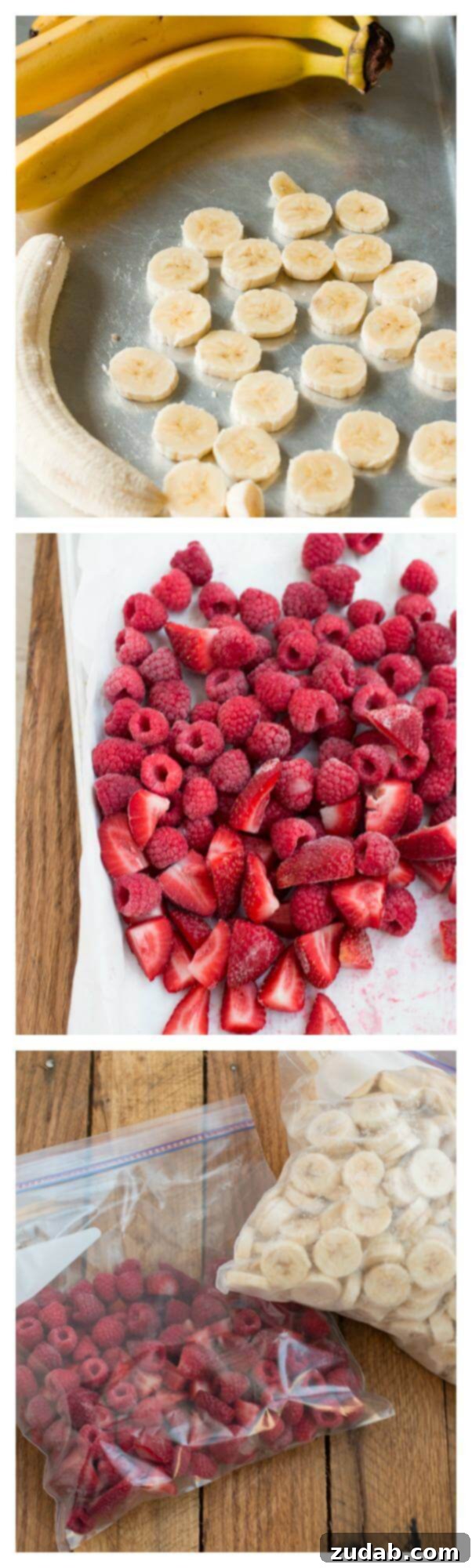
- **Chop for Convenience:** Cut larger fruits into small, uniform chunks or slices. Aim for pieces that are roughly 1/2 to 1 inch in size. Smaller pieces blend more easily and freeze faster. For example, bananas can be sliced into coins, strawberries quartered, and mangoes diced.
- **Thoroughly Dry the Fruit:** This is a crucial step to prevent ice crystal formation and freezer burn. Lay the chopped fruit out on a clean kitchen towel or paper towels and gently pat it completely dry. Any excess moisture will turn into ice, making the fruit clump together and potentially altering its texture when blended.
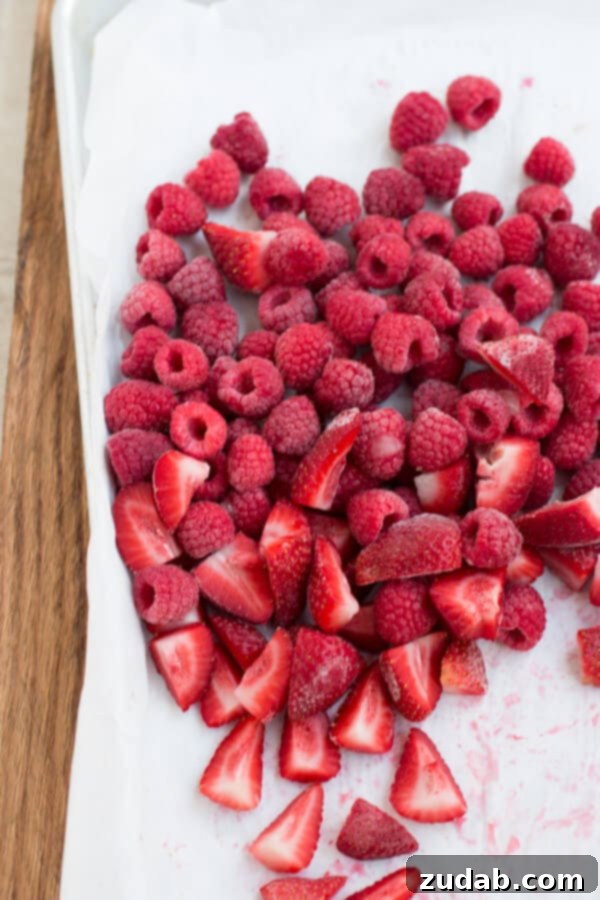
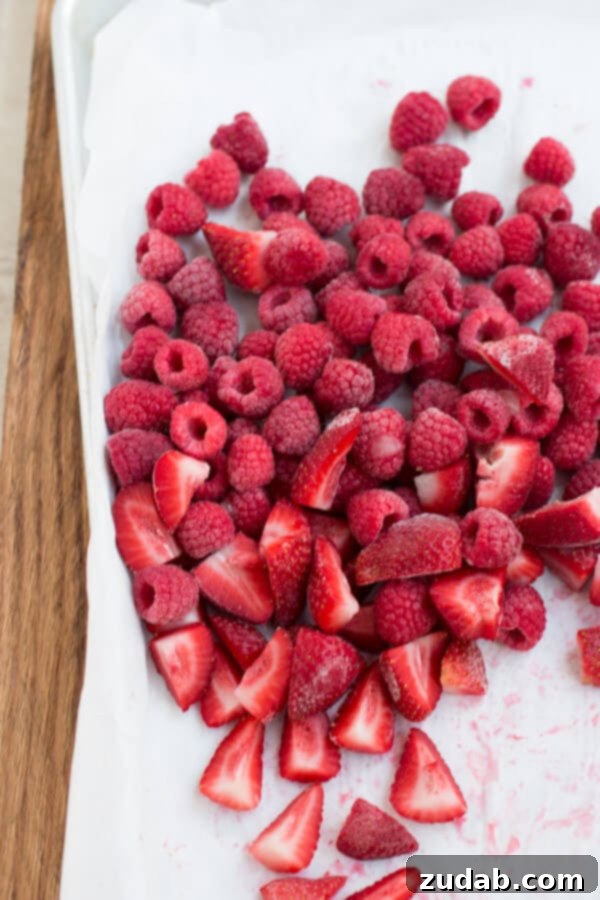
- **Flash Freeze for Best Results:** Line a large baking sheet with parchment paper or a silicone baking mat. Arrange the prepared and dried fruit in a single layer on the sheet, ensuring that no pieces are touching. This prevents the fruit from freezing into one large, solid block. Place the entire tray in the freezer for 3 hours, or up to 24 hours, until the fruit is completely solid. This “flash freezing” step ensures each piece freezes individually.
- **Store for Long-Term Freshness:** Once the fruit is thoroughly frozen, remove the tray from the freezer. Quickly transfer the individual frozen pieces into heavy-duty freezer bags or airtight freezer-safe containers. Press out as much air as possible from the freezer bags before sealing to minimize freezer burn. Label each bag or container with the type of fruit and the date it was frozen.
Properly frozen fruit, stored in airtight containers, will maintain its quality for **6-9 months**, ensuring you have a steady supply of smoothie ingredients ready whenever inspiration strikes.
Do You Need to Defrost Fruit Before Adding It to Smoothies?
Absolutely not! In fact, I strongly recommend adding fruit to your blender directly from the freezer, still entirely frozen. This is one of the key secrets to achieving **thick and creamy smoothies** without relying on ice. Frozen fruit acts as a natural thickener and provides the perfect chill without diluting the flavor. While adding a few ice cubes to a smoothie is perfectly acceptable, they melt quickly, which can result in a watery smoothie that loses its desirable consistency and concentrated taste. By using frozen fruit, you ensure your smoothie remains delightfully thick, cold, and packed with flavor from the first sip to the last, making it a truly satisfying and nutrient-dense meal.
Optimal Fruits for Freezing
Many fruits freeze exceptionally well, retaining their flavor and texture for smoothie perfection. Here’s a list of fruits that are particularly great for freezing:
- **Berries (Strawberries, Raspberries, Blackberries, Blueberries, Marionberries):** These are perhaps the easiest to freeze due to their small size and robust structure. Simply rinse, pat dry, and flash freeze. They retain their flavor beautifully.
- **Bananas:** Perfect for adding natural sweetness and creaminess. Peel them before slicing and freezing.
- **Tropical Fruits (Pineapple, Mango, Papaya):** These lend a wonderful exotic flavor to smoothies. Peel, core (if necessary), and dice before freezing.
- **Cherries (pits removed):** A fantastic choice for a sweet-tart punch. Make sure all pits are removed before freezing.
- **Avocados:** While technically a fruit, frozen avocado adds incredible creaminess and healthy fats to smoothies. Slice or mash before freezing to prevent discoloration.
- **Peaches:** Offer a delightful summery flavor. Peel (blanching helps), pit, and slice before freezing.
Beyond these, you can experiment with other fruits like grapes, kiwi, and even citrus segments. The key is proper preparation – cleaning, cutting, and flash-freezing – to lock in freshness.
Crafting Your Own Delicious Smoothie Recipes
Having a freezer full of prepped fruit means you’re always just moments away from a wholesome and delicious smoothie. Gone are the days of last-minute grocery runs for fresh produce. With your frozen fruit ready, all you need to do is combine it with a liquid, perhaps some vegetables, and any desired add-ins, then blend it up for the ultimate healthy meal. For the best results and a consistently smooth texture, we highly recommend investing in a high-quality blender like a Blendtec blender. Here are some of our favorite smoothie recipes that all utilize frozen fruit:
- **Cold Bust Smoothie:** An immune-boosting blend packed with vibrant flavors. Ingredients: Orange Juice, Spinach, Fresh Orange segments, Baby Carrots, Frozen Bananas, Frozen Pineapple, Apple, and Vanilla Protein Powder.
- **Raspberry Pineapple Coconut Smoothie:** A tropical escape in a glass. Ingredients: Frozen Raspberries, Frozen Pineapple, Frozen Bananas, Coconut Extract, Creamy Coconut Milk, and a touch of Honey or Agave for sweetness.
- **Peach Berry Protein Green Smoothie:** A powerful and satisfying blend, perfect for a post-workout refuel or a hearty breakfast. Ingredients: Almond or Coconut Milk, Vanilla Protein Powder, Fresh Spinach, Frozen Mixed Berries, Frozen Bananas, Frozen Peaches, topped with Granola, Chia Seeds, and Sliced Almonds.
- **Pineapple Orange Banana Green Smoothie:** A refreshing and zesty green smoothie. Ingredients: Spinach, Frozen Banana, Frozen Pineapple, Mandarin Orange segments, Milk (dairy or non-dairy), and Chia Seeds.
- **Protein Green Smoothie Granola Parfait:** A versatile recipe that can be enjoyed as a smoothie or layered as a parfait. Ingredients: Milk (dairy or non-dairy), Fresh Spinach, Frozen Mangoes, Frozen Bananas, Sliced Almonds, Vanilla Protein Powder, and crunchy Granola.
Tips for Building Your Perfect Smoothie:
- **Layering Matters:** For optimal blending, always add liquids first, followed by soft ingredients like greens, then frozen fruit, and finally any protein powders or seeds. This helps your blender work more efficiently.
- **Liquid Base:** Experiment with different liquids – water, milk (dairy or non-dairy like almond, soy, oat, coconut), coconut water, or fruit juice – to achieve your desired consistency and flavor profile.
- **Boosters & Add-ins:** Enhance your smoothies with nutrient-dense additions like chia seeds, flax seeds, hemp hearts, nut butters, protein powder, spirulina, or even a scoop of oatmeal for extra fiber.
- **Meal Prep Smoothie Packs:** For ultimate convenience, create individual smoothie packs. Simply combine all the dry and frozen ingredients (excluding liquid) for one smoothie in a freezer-safe bag. When ready to blend, just dump the contents into your blender, add your liquid, and blend!
By taking a little time to **freeze fruit for smoothies** ahead of time, you’re not just preparing ingredients; you’re setting yourself up for success. You’ll be ready to whip up incredibly creamy, flavorful, and filling **healthy breakfast** smoothies every day of the week, saving time, money, and ensuring a nutritious start to your day. Enjoy the simplicity and satisfaction of homemade goodness!