
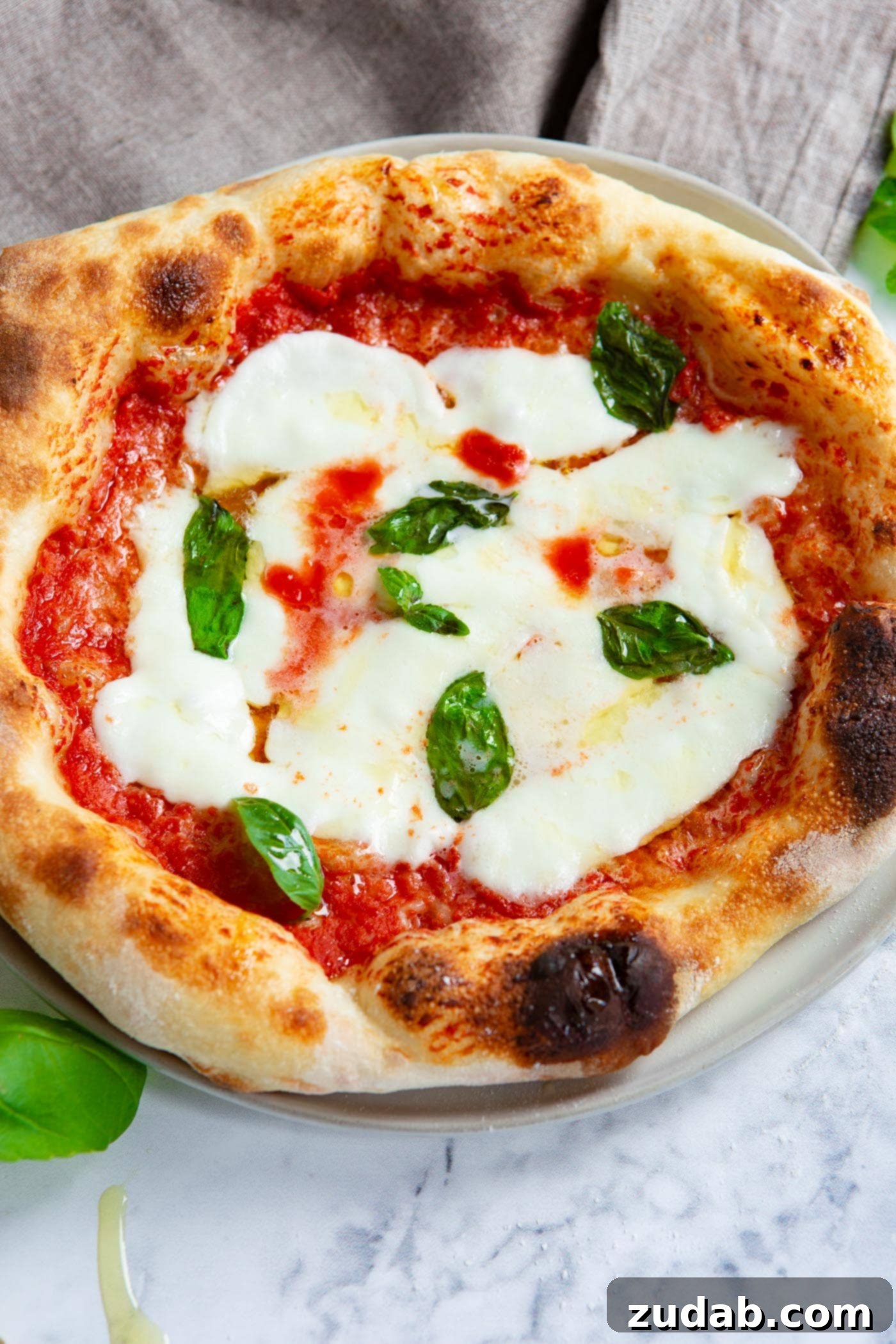
The quest for the perfect pizza often leads us back to the classics. For many, including myself, the Margherita pizza stands as the undisputed champion, a true testament to the beauty of simplicity and the power of quality ingredients. This iconic Italian creation isn’t just a dish; it’s a benchmark. You can truly gauge the authenticity and skill of any pizzeria by the quality of their Margherita. If they can’t master this most basic, pure form of pizza, then there’s little hope for their more complex offerings. It might sound a bit harsh, but this philosophy has consistently guided me to the finest pizza experiences.
My culinary journey led me to create an authentic **Margherita pizza recipe** that proudly competes with the incredible pies I savored during my travels in Italy. This isn’t just any pizza; it’s an homage to tradition, designed to bring the true taste of Naples right into your home kitchen. We’ll delve into crafting a flawless **Neapolitan crust**, renowned for its distinctively thin and delightfully chewy texture, which serves as the ideal foundation for the Margherita’s delicate yet vibrant flavors.
Preparing homemade pizza is a rewarding experience, and mastering the Margherita is a fundamental step. It celebrates the artistry of Italian cooking, emphasizing fresh, high-quality components over complicated preparations. This guide will walk you through every step, ensuring your homemade Margherita pizza is nothing short of spectacular. Get ready to impress your family and friends with a pizza that evokes the sunny streets of Italy with every bite.
Unlocking the Secrets of Authentic Margherita Pizza: A Step-by-Step Guide
Creating an exceptional Margherita pizza doesn’t require an extensive list of ingredients or a complicated process. In fact, its brilliance lies in its simplicity and the superior quality of a few key components. This recipe focuses on maximizing flavor with minimal fuss, ensuring every element contributes to a harmonious and authentic taste. For the crust, you’ll need just five ingredients, the sauce requires only two, and the toppings a mere three. It truly couldn’t be more straightforward!
The Foundation: Ingredients for the Perfect Margherita Pizza
The secret to an authentic Margherita pizza lies not in complexity, but in the inherent quality and freshness of its few, carefully selected ingredients. Each component plays a vital role, contributing to the pizza’s iconic taste and texture. Sourcing the best possible ingredients is paramount to recreating the magic of an Italian pizzeria in your own home. Here’s a detailed look at what you’ll need to craft your masterpiece:
For the Neapolitan-Style Dough:
The crust is the backbone of any great pizza, and for a Margherita, a thin, chewy Neapolitan-style base is essential. This requires specific flour and precise measurements to achieve the desired texture and airy, blistered edges.
- Baker’s Flour (or 00 Flour): This is the cornerstone of an authentic Neapolitan crust. Baker’s flour, similar to high-protein bread flour, creates a robust gluten structure, yielding that signature chewy texture we crave in pizza. Even better, if you can find it, is “00 flour.” This finely milled Italian flour boasts a high protein content perfect for pizza and pasta dough, resulting in an incredibly tender crumb and crisp exterior. Using 00 flour will elevate your crust to professional levels.
- Warm Water (105-115 degrees F): The water temperature is crucial for activating the yeast properly. Water that’s too cold won’t wake up the yeast, while water that’s too hot can kill it. Aim for a gentle warmth that feels comfortable to the touch.
- Fine-Grain Sea Salt: Essential for flavor, sea salt also plays a role in controlling yeast activity and strengthening the gluten network, contributing to the dough’s elasticity and taste.
- Granulated Sugar: A small amount of sugar acts as food for the yeast, helping it activate more quickly and contributing to a beautiful golden-brown crust.
- Instant Yeast: For this recipe, instant yeast is recommended as it can be mixed directly with the dry ingredients without prior proofing, saving time and simplifying the process. Avoid using active dry yeast unless you’re prepared to proof it separately.
For the Simple, Flavorful Sauce:
The sauce for a true Margherita is remarkably simple, allowing the natural sweetness of the tomatoes to shine through. No elaborate cooking or a multitude of herbs are needed.
- San Marzano Tomatoes: These are non-negotiable for an authentic Italian pizza sauce. Hailing from the Agro Sarnese-Nocerino region of Italy, San Marzano tomatoes are known for their sweet, balanced flavor, low acidity, thick flesh, and fewer seeds. Whether you find them whole, crushed, or diced, they all end up in the blender for a smooth, vibrant sauce. Their unique characteristics are what give Margherita pizza its distinctive taste.
- Fine-Grain Sea Salt: Just a touch of sea salt is all that’s needed to enhance the inherent sweetness and depth of the San Marzano tomatoes, creating a perfectly seasoned sauce.
For the Classic, Iconic Toppings:
The toppings on a Margherita pizza are minimal but mighty, each representing a color of the Italian flag: red (tomatoes), white (mozzarella), and green (basil).
- Fresh Mozzarella: Opt for fresh mozzarella, ideally “fior di latte” (cow’s milk mozzarella) or, if you’re feeling luxurious, buffalo mozzarella. These fresh varieties melt beautifully, offering a creamy texture and delicate flavor. Tear the cheese into irregular pieces rather than slicing, as this creates pockets of molten cheese that are characteristic of traditional Margherita. You can adjust the quantity to your preference, from a sparse scattering to a more generous coating.
- Fresh Basil Leaves: The aromatic, vibrant green of fresh basil is crucial. I prefer to leave the leaves whole and scatter them over the pizza *after* it comes out of the oven. This preserves their delicate flavor and prevents them from burning and turning bitter during baking. Use as many fresh leaves as your heart desires!
- High-Quality Olive Oil: A final drizzle of extra virgin olive oil over the baked pizza adds a subtle richness, a hint of fruity bitterness, and a glossy finish that is classic to a Margherita pizza. Choose a good quality oil for the best results.
Detailed measurements for each ingredient, along with precise instructions, can be found in the recipe section below. You’ll also find options to save or print the recipe for future use.
Essential Tools for Crafting the Ultimate Homemade Pizza
While passion and quality ingredients are paramount, having the right tools can significantly enhance your homemade pizza experience, making it easier to achieve professional-level results. These items aren’t strictly mandatory for making pizza, but they will undoubtedly elevate your crust, simplify handling, and ensure your Margherita pizza is cooked to perfection every time.
- Pizza Stone or Pizza Steel: This is arguably the most important tool for achieving a crispy, perfectly cooked crust. Both a pizza stone and a pizza steel absorb and retain a tremendous amount of heat, mimicking the intensely hot environment of a traditional pizza oven. When the raw dough hits this superheated surface, it cooks rapidly from the bottom up, creating a beautifully blistered and crisp crust. A steel generally heats up faster and retains heat more efficiently, making it a favorite for many home bakers.
- Pizza Peel: A pizza peel is indispensable for transferring your assembled pizza into and out of the screaming hot oven. Dusting it lightly with flour, semolina, or cornmeal allows the dough to slide effortlessly onto the hot stone or steel. It prevents burns and makes handling the delicate dough much easier, ensuring your perfectly shaped pizza arrives in the oven intact.
- Kitchen Scale: For truly consistent and professional-quality pizza dough, a kitchen scale is highly recommended. Measuring flour and water by weight rather than volume ensures accuracy, which is vital for proper hydration and dough consistency.
- Stand Mixer with Dough Hook: While hand-kneading is traditional and therapeutic, a stand mixer can save time and effort, especially if you’re making multiple batches of dough. The dough hook attachment efficiently develops gluten, resulting in a smooth, elastic dough.
- High-Heat Oven: Though not a “tool” in the conventional sense, a home oven capable of reaching 500-550°F (260-290°C) is essential. High heat is critical for quickly cooking the pizza and achieving that classic Neapolitan char on the crust.
What Exactly is a Margherita Pizza? A Timeless Italian Classic
The Margherita pizza is more than just a pizza; it’s a culinary legend. Originating in Naples, Italy, its creation is often attributed to Raffaele Esposito, a pizza maker who, in 1889, prepared a pizza for Queen Margherita of Savoy. The toppings were deliberately chosen to represent the colors of the Italian flag: red from the tomatoes, white from the mozzarella cheese, and green from the fresh basil. This simple yet profound combination quickly became a national symbol and a global favorite.
Traditionally, a Margherita pizza is characterized by its sparse application of high-quality ingredients: San Marzano tomatoes for the sauce, fresh mozzarella (often Fior di Latte), fresh basil leaves, a drizzle of extra virgin olive oil, and a touch of salt. The crust is thin in the middle with a puffed, airy, and slightly charred edge known as the *cornicione*. The beauty of the Margherita lies in its ability to highlight the individual flavors of these premium components, demonstrating that less truly can be more.
Understanding Your Flour: Baker’s Flour vs. 00 Flour
The type of flour you choose is paramount to achieving the desired texture for your pizza crust. For a Neapolitan-style Margherita, specific flours are key to creating that perfect thin and chewy base.
Baker’s flour is a type of flour that has a higher protein content, typically around 12-14%. This higher protein level is crucial because it leads to greater gluten development when mixed with water and kneaded. Gluten is the protein network that gives dough its elasticity and chewiness, exactly what you want in a substantial yet yielding pizza crust. It allows the dough to stretch thin without tearing and creates those desirable air pockets during baking.
Alternatively, you can use **00 flour**, which is a finely ground Italian flour. The “00” classification refers to its super-fine texture, almost like talcum powder. Despite its fine grind, traditional Italian 00 flours for pizza (like Caputo Pizzeria or Antimo Caputo Chef’s Flour) also have a high protein content, specifically designed for high-heat pizza baking. This combination of fine grind and high protein results in a dough that is both incredibly extensible (easy to stretch) and produces a crust that is crisp on the outside and wonderfully tender and airy on the inside. It’s often the flour of choice for authentic Neapolitan pizza makers.
While 00 flour can be slightly harder to find in conventional grocery stores and may come at a higher price point, the results it yields for pizza and pasta dough are exceptional. Many specialty food stores, Italian markets, or online retailers carry it. For readers in specific regions, local gourmet supermarkets or larger chain stores might also stock it.
The Marvel of San Marzano Tomatoes
When it comes to authentic Italian pizza sauce, not all tomatoes are created equal. **San Marzano tomatoes** are a specific variety of plum tomatoes, renowned globally for their superior flavor and texture, making them the preferred choice for premium sauces.
These tomatoes are cultivated in the Sarno River valley near Naples, Italy, a region protected by a “D.O.P.” (Denominazione d’Origine Protetta) certification. This designation ensures that only tomatoes grown, harvested, and processed according to strict traditional methods within this specific area can bear the authentic San Marzano name. This guarantees their quality and origin, much like Champagne or Parmesan cheese.
Characteristics that make San Marzano tomatoes ideal for sauce include:
- Distinctive Shape: They are typically elongated and cylindrical, with a pointed end.
- Sweetness and Low Acidity: San Marzanos have a naturally sweet flavor profile with a balanced acidity, which means your sauce won’t require much, if any, added sugar to achieve a rich taste.
- Thick Flesh and Fewer Seeds: Their meaty texture and lower water content make for a thicker, more concentrated sauce that doesn’t make your pizza soggy.
- Easy to Peel: The thin skin of San Marzano tomatoes is easily removed, contributing to a smoother sauce.
While other plum tomato varieties can be used, none quite replicate the depth and authenticity that San Marzano tomatoes bring to a classic Margherita pizza sauce. Always look for the D.O.P. seal on the can to ensure you are getting genuine San Marzano tomatoes.
Clarifying Common Questions About Margherita Pizza
Does Margherita Pizza Contain Alcohol?
No, an authentic Margherita pizza, made with fresh San Marzano tomatoes, mozzarella cheese, and fresh basil, does not contain any alcohol. There seems to be a common misunderstanding because of a popular cocktail also named ‘Margarita’ (often spelled with an ‘a’ instead of ‘e’). The Margarita cocktail, typically made with tequila, lime juice, and triple sec, is an entirely separate entity and has absolutely no connection to the Italian pizza. You can enjoy your Margherita pizza without any concern about alcoholic content.
What is the Best Way to Reheat Leftover Pizza?
While some people swear by cold pizza, a perfectly reheated slice can be just as enjoyable as when it was fresh out of the oven. If you’re looking to bring your leftover Margherita pizza back to life, the method you choose can make all the difference in preserving its crust and flavor. Here are a few popular methods, with the stovetop technique being the clear winner for crispiness:
- The Stovetop Method (Highly Recommended): This method is hands-down the best for restoring that desirable crispy crust.
- Heat a heavy-bottomed skillet (cast iron works wonderfully) over medium heat for a minute or two.
- Add a tiny drop of olive oil to the pan – just enough to lightly coat the bottom.
- Place your slice(s) of pizza in the hot skillet and cook for about 2-3 minutes, or until the bottom is wonderfully crisp and golden.
- Reduce the heat to low. Add two drops of water along the edge of the skillet (not directly on the pizza), then immediately cover the skillet with a lid.
- Allow it to cook for another 1-2 minutes. The steam trapped under the lid will gently melt the cheese and warm the toppings without making the crust soggy. You’ll be left with a perfectly crisp bottom and melty cheese.
- The Oven Method: This is a great alternative if you have multiple slices or an entire pizza to reheat.
- Preheat your oven to 375°F (190°C).
- Place the pizza directly on the oven rack or on a baking sheet lined with parchment paper.
- Bake for 5-10 minutes, or until the cheese is melted and bubbly and the crust is crisp. For an extra crispy bottom, place it on a preheated pizza stone or steel for the last few minutes.
- The Microwave (Quick, but not ideal for quality): If you’re in a real hurry and texture isn’t your top priority, the microwave is an option.
- Place your pizza slice(s) on a microwave-safe plate.
- Microwave for 30-60 seconds, or until heated through. Be warned: the crust will likely be soft and possibly chewy, not crisp.
For the best experience, especially with a delicate pizza like the Margherita, the stovetop or oven method will give you results closest to its freshly baked glory.
Tips for Margherita Pizza Perfection at Home
Crafting the perfect homemade Margherita pizza goes beyond just following a recipe; it involves understanding a few key principles that elevate it from good to truly exceptional:
- Plan Ahead for the Dough: The best Neapolitan-style pizza dough benefits greatly from a long, cold fermentation. Prepare your dough at least 24 hours in advance and let it slowly proof in the refrigerator. This develops incredible flavor and a more tender, airy crust.
- Achieve Maximum Oven Heat: Professional pizza ovens reach extremely high temperatures. To mimic this at home, preheat your oven to its highest possible setting (500-550°F or 260-290°C) with your pizza stone or steel inside for at least 45-60 minutes. This ensures the cooking surface is screaming hot, guaranteeing a quick cook time and a crispy crust.
- Handle Dough Gently: Once your dough is at room temperature, handle it with care. Use flour to prevent sticking, but avoid over-flouring which can make the crust tough. Gently press and stretch the dough from the center outwards, preserving the air bubbles in the rim for that characteristic *cornicione*.
- Don’t Overload: The beauty of Margherita is its simplicity. Resist the temptation to pile on too many toppings. A light hand with sauce, cheese, and basil allows each flavor to stand out and prevents a soggy pizza.
- Add Basil Post-Bake: For the freshest flavor and vibrant green color, scatter your fresh basil leaves over the pizza immediately after it comes out of the oven. Baking basil for too long can cause it to blacken and become bitter.
- A Dash of Finishing Oil: A final drizzle of high-quality extra virgin olive oil just before serving adds an extra layer of flavor and a beautiful sheen.
It’s simple, it’s profoundly flavorful, and in my humble opinion, it’s the most exquisite pizza ever created! Make this **authentic Margherita pizza recipe** for your next homemade pizza night with the family. I just know you’re going to fall in love with it!
Delicious Pizza Recipes You’re Sure to Love:
- Pesto Pepperoni and Sausage Grilled Pizza
- Elote Mexican Corn Grilled Pizza
- Pepperoni Pizza Stuffed Crescent Rolls
- Pepperoni Pizza Dip
- Homemade Pizza Sauce
- Zucchini Pizza Crust
- Pulled Pork Pizza
- Grilled Garlic Naan Pizza
- All Our Pizza Recipes!
Classic Margherita Pizza
By Sweet Basil
Prep Time: 3 hrs 10 mins
Cook Time: 20 mins
Total Time: 3 hrs 30 mins
Servings: 4 pizzas
Rated 5 stars from 1 vote
Ingredients
For the Dough:
- 1 Batch Pizza Dough (*see note)
For the Sauce:
- 1 Can San Marzano Tomatoes, 14 oz (**see note)
- 3/4 teaspoon Fine-Grain Sea Salt
For the Toppings:
- 8 Ounces Fresh Mozzarella, torn into pieces
- Fresh Basil, whole leaves (a few are all you need)
- Olive Oil, for drizzling on top
Instructions
For the Crust:
- Prepare the pizza dough according to the instructions in the linked recipe, ideally 24 hours in advance for best flavor and texture.
- Approximately 60-90 minutes before baking, remove the dough from the refrigerator to allow it to come to room temperature.
- Place a pizza stone or steel on the upper rack of your oven and preheat the oven to its maximum temperature, ideally 550°F (290°C), for 45 to 50 minutes to ensure it is thoroughly heated.
- Once the pizza stone is ready, lightly dust your counter with flour. Gently shape the dough by pressing from the middle outward and rotating the dough as you go, aiming for a thin base with a slightly thicker edge.
- Dust a pizza peel with a little flour or semolina and carefully place the shaped dough on top.
For the Sauce:
- Pour the San Marzano tomatoes (whole, crushed, or diced) and sea salt into a blender. Blend until completely smooth (***see note for storage).
Assembling and Baking:
- Spread the smooth tomato sauce evenly over the dough, leaving a 1/2 to 1-inch border around the edge for the crust. Use the back of your spoon to gently smooth it.
- Turn your oven’s broiler on for five minutes to give the stone or steel an extra boost of heat. Carefully slide the pizza off the pizza peel and onto the preheated pizza stone inside the oven. Immediately turn the broiler off and set the oven back to its highest temperature (550°F/290°C).
- Allow the pizza to bake for a few minutes (typically 5-8 minutes, depending on your oven and desired crispness). Open the oven door and carefully slide the partially baked pizza back onto the pizza peel.
- At this point, you have a couple of options, reflecting different Italian traditions: you can either drizzle a small tablespoon of olive oil all over the pizza, or you can go straight to scattering the torn fresh mozzarella pieces and fresh basil leaves over the pizza.
- Gently slide the pizza back onto the pizza stone in the oven for another 1 to 2 minutes, or until the cheese is beautifully melted and bubbly, and the crust has achieved its desired char.
- Remove the pizza from the oven. You may add a final drizzle of fresh olive oil, slice, and serve immediately. Enjoy your authentic homemade Margherita pizza!
Recipe Notes
*I highly recommend letting the pizza dough rest and cold ferment for up to 24 hours before baking. Take this into account when planning your pizza night for optimal flavor development.
**San Marzano tomatoes can sometimes be hard to find in the 14oz can size. If you need to use a 28oz can, simply use half for this recipe, or double the sauce ingredients and freeze the other half for later use.
***Unused sauce can be stored in an airtight container in the refrigerator for 5-7 days or frozen for up to 3 months.
Nutrition
Serving: 1 pizza, Calories: 204kcal, Carbohydrates: 9g, Protein: 14g, Fat: 13g, Saturated Fat: 8g, Polyunsaturated Fat: 1g, Monounsaturated Fat: 4g, Cholesterol: 45mg, Sodium: 929mg, Potassium: 344mg, Fiber: 2g, Sugar: 5g, Vitamin A: 604IU, Vitamin C: 9mg, Calcium: 322mg, Iron: 2mg
Nutrition information is automatically calculated and should be used as an approximation.
REMEMBER TO SUBSCRIBE TO our FREE Oh Sweet Basil NEWSLETTER AND RECEIVE EASY RECIPES DELIVERED INTO YOUR INBOX EVERY DAY!
When you try a recipe, please use the hashtag #ohsweetbasil on INSTAGRAM for a chance to be featured in our stories! FOLLOW OH, SWEET BASIL ON FACEBOOK | INSTAGRAM | PINTEREST | TWITTER FOR ALL OF OUR LATEST CONTENT, RECIPES AND STORIES