
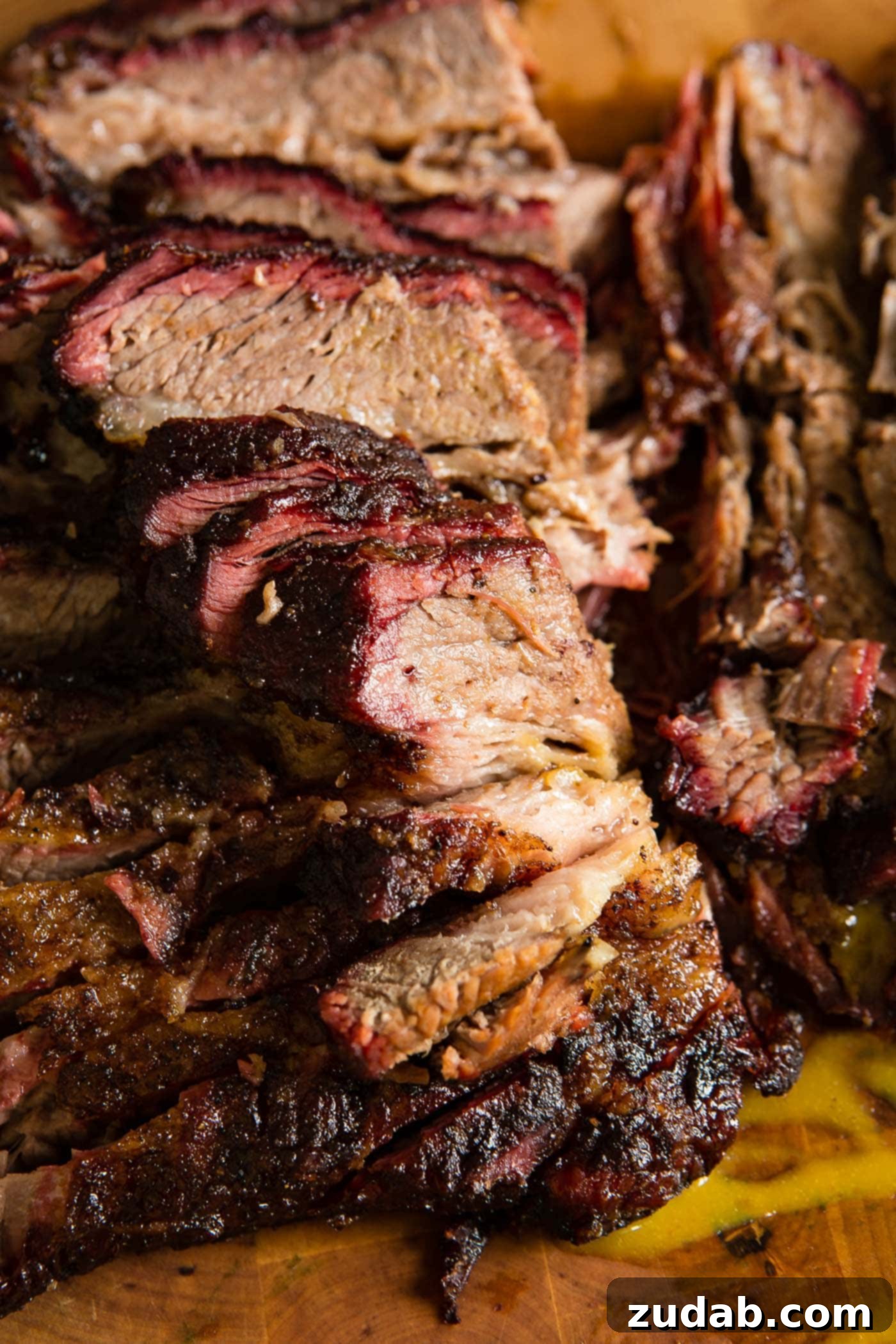
Unlock the secrets to crafting the ultimate Smoked Brisket with this comprehensive guide. We’ll walk you through a foolproof smoked brisket recipe, ensuring a flawless, melt-in-your-mouth result every single time. Prepare to elevate your barbecue game and impress friends and family with a dish that embodies the very essence of savory, smoky perfection.
Imagine serving this incredibly tender brisket alongside classic BBQ favorites like a creamy macaroni salad or warm, sweet cornbread. This combination isn’t just a meal; it’s an experience that transports you straight to barbecue heaven.
This post is a collaboration with Beef. It’s What’s For Dinner. I received compensation, but all opinions are my own.
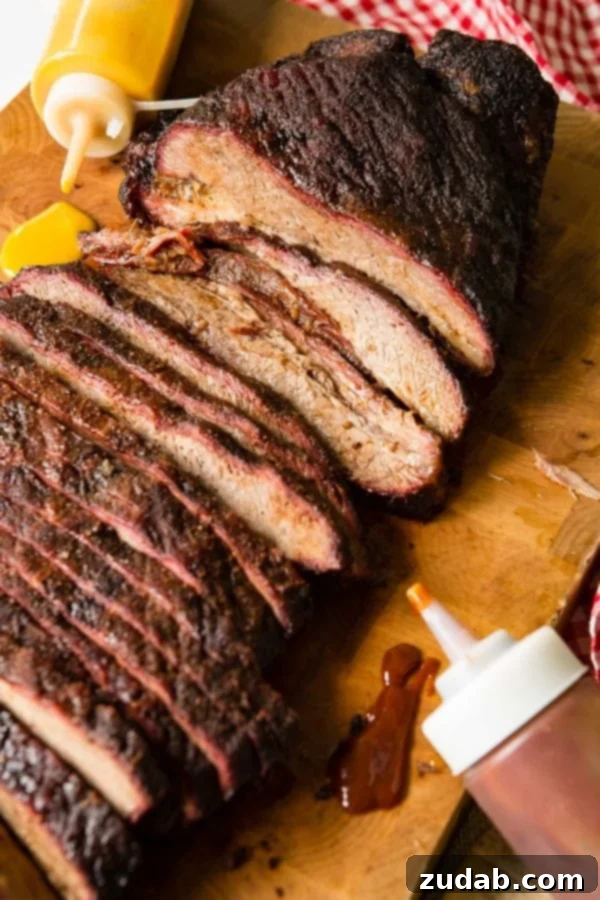
Mastering Smoked Brisket on a Traeger (or any Pellet Smoker)
There’s an undeniable satisfaction that comes from smoking a premium cut of beef to perfection. Beef, renowned for its rich flavor and robust texture, is an unparalleled protein. Beef offers endless culinary possibilities, whether seared, grilled, roasted, or as the star of your main course. But when you introduce a wood pellet smoker, like a Traeger, into the equation, you unlock an entirely new dimension of flavor and tenderness that is simply unmatched.
Brisket, a large and often expensive cut, demands respect and precision. Our method, perfected over countless hours, ensures that your investment in this magnificent piece of meat yields extraordinary results. The beauty of a pellet smoker lies in its ability to maintain consistent temperatures and produce a steady stream of pure wood smoke, making the journey to a perfectly smoked brisket surprisingly accessible, even for beginners. The quality you’ll achieve is truly top-shelf, rivaling that of any professional BBQ joint.
Understanding the Brisket Cut
Before we dive into the smoking process, let’s understand what a brisket actually is. Brisket is a primal cut of beef taken from the breast or lower chest of a cow. Often, you’ll encounter it labeled as a “whole packer brisket,” which includes two distinct muscles: the “point” and the “flat.” The flat, or first cut, is leaner and more uniform, making it ideal for slicing. The point, or second cut, is fattier, richer, and often used for chopped brisket or burnt ends.
Traditionally, brisket is considered one of the toughest cuts of beef due to its high connective tissue content. However, this characteristic makes it an ideal candidate for low-and-slow cooking methods like smoking, braising, or slow roasting. Over time, the collagen breaks down into gelatin, transforming the tough fibers into incredibly juicy, tender, and flavorful beef bliss. All you need is patience, the right tools, and a few simple, expert tricks.
It’s crucial to recognize the lean and fatty sides of a brisket. Both play a vital role in achieving the succulent smoked brisket we’re aiming for. The lean flat section has a tighter grain and can be challenging to tenderize. Mastering this aspect is where true pitmasters distinguish themselves. Our recipe is specifically designed to help you achieve that coveted melt-in-your-mouth texture, even on the leanest parts.
Your Step-by-Step Guide to Smoking Brisket
Let’s get straight to the heart of the matter: the best way to smoke a brisket. Follow these detailed steps to ensure your brisket is the star of your next BBQ gathering.
Step 1: Selecting Your Brisket – Quality Matters
The journey to an amazing smoked brisket begins long before the smoker is even lit. Choosing the right cut is paramount. Here are a few invaluable tricks we’ve learned over the years:
- Beef Grade: Brisket comes in three primary grades: Prime, Choice, and Select.
- Prime: This is the highest quality, boasting abundant marbling (intramuscular fat) that renders into incredible juiciness and flavor during the long smoke. If your budget allows, always opt for Prime.
- Choice: An excellent and more widely available option, Choice grade beef still has good marbling and delivers fantastic results when smoked properly.
- Select: While more economical, Select grade has less marbling, which can make it drier and less forgiving during the long cooking process. We recommend aiming for at least Choice grade for the best experience.
- Flexibility: When selecting your brisket, pick it up by one end. A good brisket should have a noticeable amount of flexibility and sag slightly. Avoid overly stiff briskets, as this can indicate tough internal fat or less marbling.
- Even Flat Section: Look for a brisket with a relatively even thickness in the flat section. This promotes more uniform cooking and prevents thinner areas from drying out before thicker sections are done.
- Untrimmed (Packer): Whenever possible, purchase an untrimmed, or “packer,” brisket. This allows you to control the fat cap thickness and remove any undesirable silver skin or hard fat yourself, which is crucial for bark development and even cooking.
Step 2: Preparing Your Brisket – The Art of Trimming and Seasoning
Proper trimming is a critical step that significantly impacts the final product. Place your brisket fat side down on a large, clean cutting board. Carefully trim off any silver skin, a thin, silvery membrane that won’t render during cooking and will result in a tough, chewy layer. Also, remove any excessively hard or irregular fat from the flat end of the muscle. The goal is to create a smooth, even surface that allows for consistent smoke penetration and bark formation.
Next, “square up” the edges of the brisket. This means trimming off any thin, wispy pieces of meat or fat that would otherwise burn or cook unevenly. A more uniform shape ensures a consistent cooking experience. Flip the brisket over to the fat cap side. This layer of fat is essential for moisture, but too much can prevent bark formation and proper smoke absorption. Trim the fat cap down to a consistent thickness of approximately 1/4 inch. This ideal thickness protects the meat while allowing the smoke to penetrate and create a flavorful bark.
Once trimmed, it’s time for the dry rub. In a small bowl, combine your chosen spices (as listed in the recipe below). Generously rub this mixture all over both sides of the brisket, ensuring every surface is coated. Don’t be shy – the rub creates the foundation of the brisket’s flavorful bark.
Step 3: The Initial Smoke – Developing that Signature Bark
Preheat your Traeger or other wood pellet smoker to a stable 225 degrees Fahrenheit. While the smoker is preheating, consider your wood choice – this will impart the primary smoke flavor (see our section on wood types below for recommendations). Once the smoker reaches temperature, place your prepared, unwrapped brisket inside. Orient the brisket with the pointed end (the fattier part) facing the main heat source of your smoker, as this area can handle more direct heat. There’s much debate among pitmasters about whether to place it fat side up or fat side down; ultimately, it largely depends on your smoker’s heat distribution and personal preference. Experiment to see what works best for your setup.
Close the lid and begin the initial smoking phase. This stage is crucial for developing the characteristic “bark” and absorbing rich smoke flavor. Monitor the internal temperature of the brisket using a reliable meat thermometer. Smoke the brisket until it reaches an internal temperature of approximately 165 degrees Fahrenheit. This phase typically takes about 8-9 hours, but remember that every brisket is different, and temperature, not time, is your true indicator. During this period, you may notice the “stall,” where the brisket’s temperature temporarily plateaus. This is normal and occurs as moisture evaporates from the surface, cooling the meat. Be patient and resist the urge to increase the smoker temperature prematurely.
Step 4: The Wrap – Pushing Through the Stall for Tender Juiciness
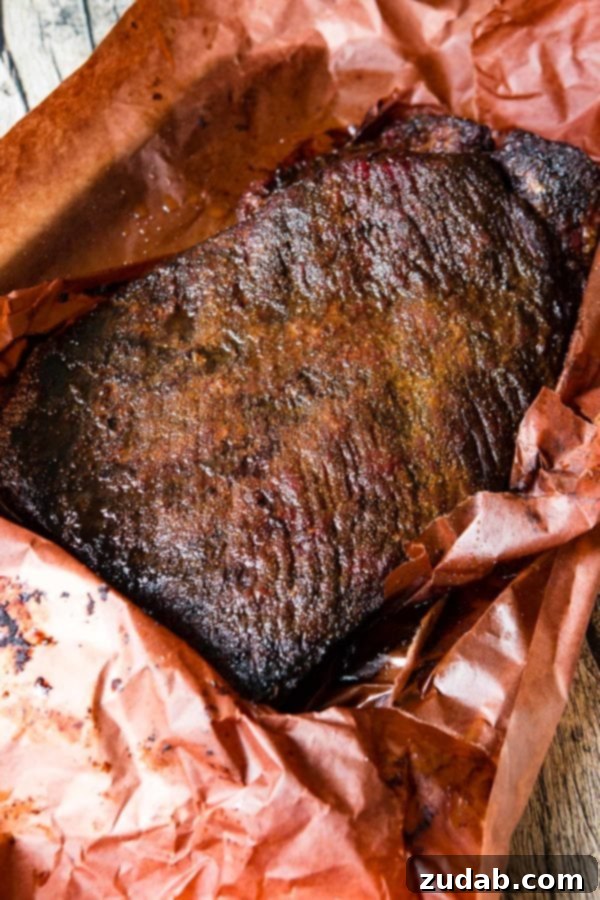
Once your brisket hits that 165-degree mark, it’s time for the “Texas Crutch” – wrapping the brisket. Roll out a large sheet of peach butcher paper on a clean work surface. Peach butcher paper is preferred over aluminum foil because it allows the brisket to breathe slightly, preserving more of that precious bark while still retaining moisture and accelerating the cooking process through the stall. Carefully remove the Traeger beef brisket from the smoker and place it squarely on the butcher paper.
Before wrapping, lightly spray the brisket with a spritz of apple cider or apple juice. This adds a touch of moisture and sweetness, helping to keep the brisket juicy. Tightly wrap the brisket in the butcher paper, ensuring a good seal. Place the wrapped brisket back into the smoker, seam side down to keep the wrap secure, maintaining the 225-degree Fahrenheit temperature. Continue smoking until the internal temperature reaches between 195-202 degrees Fahrenheit in the thickest section of the meat. This secondary smoking phase will typically take an additional 3-4 hours, bringing the total cooking time to approximately 12 hours. At this stage, the orientation of the pointed end no longer matters as the brisket is fully encased.
Step 5: The Crucial Rest – Don’t Skip This Step!
Congratulations, your brisket has reached the magical internal temperature of 202 degrees Fahrenheit – the sweet spot for fall-apart tenderness (aim slightly lower, around 195-200°F, for sliceable brisket). Now, and this cannot be stressed enough, DO NOT SKIP THIS STEP! Remove the smoked beef brisket from the Traeger and let it rest for a minimum of 1-2 hours, though many pitmasters advocate for even longer, up to 4 hours. The resting period is absolutely critical for the most tender and juiciest Traeger brisket.
During the rest, the internal temperature of the brisket will continue to rise slightly (carryover cooking) before gradually cooling. More importantly, the muscle fibers relax, allowing the reabsorption and redistribution of those precious juices throughout the meat. If you slice it too early, those juices will run out onto your cutting board, leaving you with a drier, less flavorful brisket. For an optimal rest, wrap the butcher-paper-encased brisket in an old towel and place it in an empty cooler. This creates an insulated environment, slowly bringing down the temperature and ensuring maximum juiciness.
Step 6: Slicing Your Brisket – Against the Grain
Once your perfectly rested smoked brisket has completed its rest, it’s time for the final, satisfying step: slicing. This might seem straightforward, but slicing brisket correctly is crucial for tenderness. You’ll want to slice against the grain for both the flat and the point sections. Refer to the detailed sections below for proper slicing techniques. Serve your magnificent creation with all your favorite BBQ sides and bask in the glory of a perfectly smoked brisket!
How to Properly Slice Smoked Brisket for Maximum Tenderness
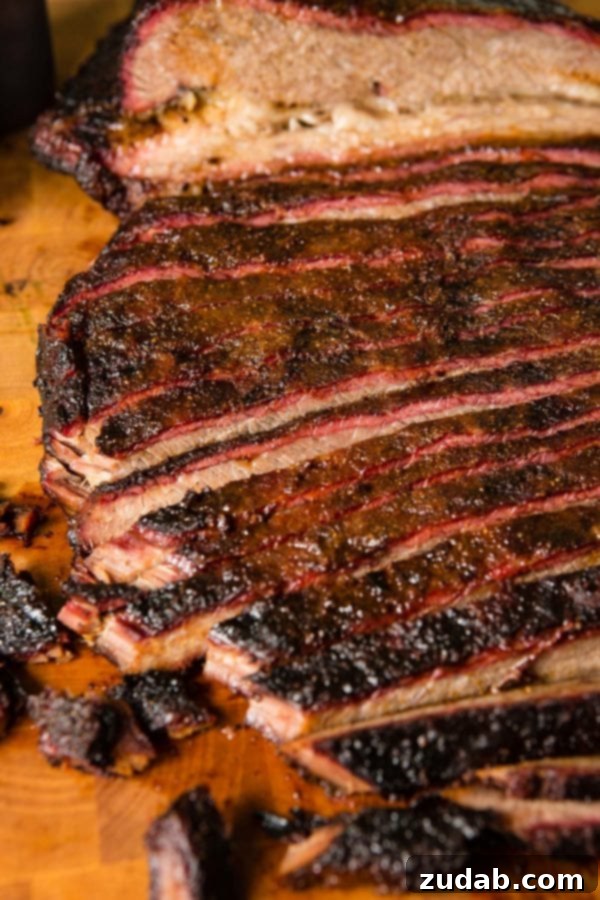
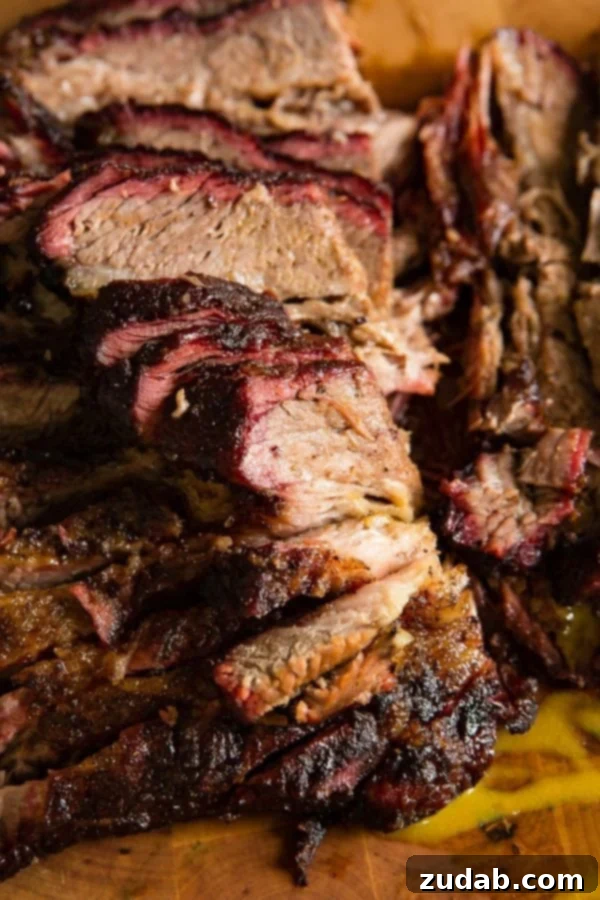
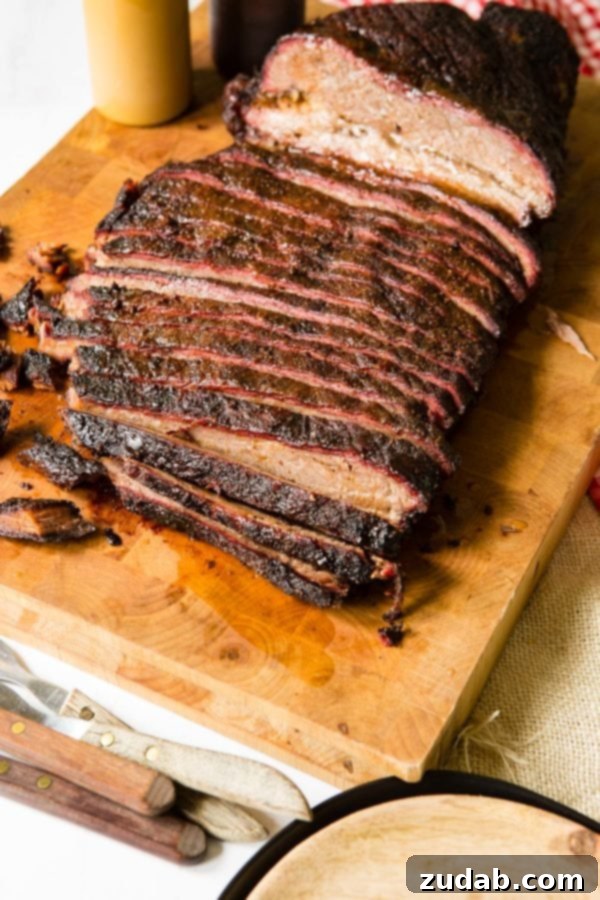
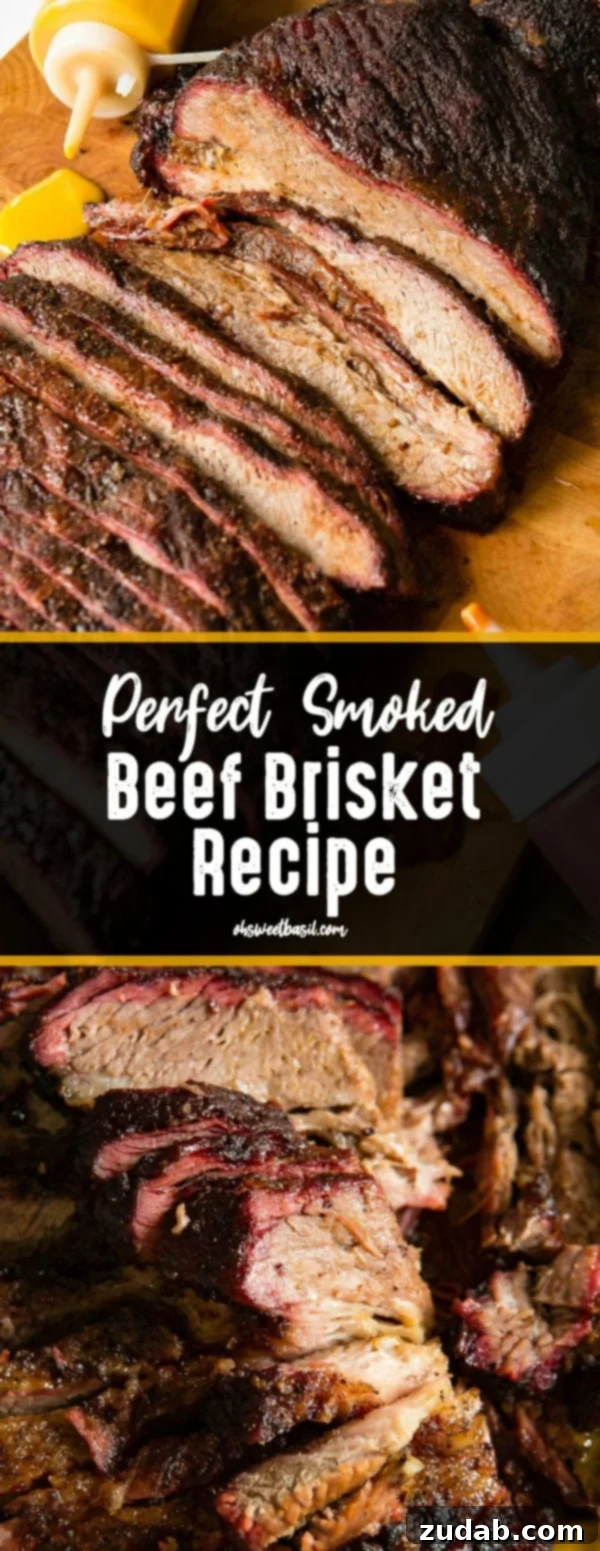
Slicing brisket can be tricky due to its unique anatomical structure. A whole packer brisket contains two distinct muscles—the flat and the point—layered on top of each other, with their muscle fibers running in different directions. The key to ensuring tenderness in every bite is to slice against the grain. Using a long, sharp slicing knife, approach the flat section first. Identify the direction of the muscle fibers and slice perpendicularly to them, creating uniform slices, typically about a pencil’s thickness.
As you approach where the flat and point sections meet, you’ll notice a change in the grain direction. At this juncture, it’s often easiest to completely separate the point from the remaining flat. Then, rotate the point section 90 degrees and slice against its grain. Some pieces from the point might not look as uniform, but they will be incredibly tender and flavorful. This two-part slicing method ensures that both the leaner flat and the richer point are served at their optimal tenderness.
Why Slice Against the Grain?
Yes, the direction you cut meat unequivocally matters. Slicing against the grain means cutting across the muscle fibers rather than parallel to them. This action effectively shortens the muscle fibers, making them easier to chew and giving you that coveted tender, melt-in-your-mouth experience. If you were to slice with the grain, the long muscle fibers would remain intact, resulting in a chewy, stringy, and far less enjoyable piece of beef. It’s a simple technique that makes a world of difference in the final eating quality of your smoked brisket.
Determining When Your Smoked Brisket is Done
The most reliable indicator that your Traeger brisket is done is when it reaches an internal temperature of 202 degrees Fahrenheit in the thickest part of the flat. However, temperature is just one factor. A truly finished brisket will also pass the “probe tender” test. Insert a meat thermometer probe into various parts of the brisket, especially the flat. If it slides in with minimal resistance, like pushing into warm butter, then your brisket is perfectly tender. This “feel” test is just as important as the temperature reading, as it confirms that the connective tissues have completely broken down.
What to Serve with Your Perfect Smoked Brisket
Now that you’ve mastered the art of creating perfectly juicy pellet grill brisket, it’s time to assemble a feast! Brisket is the centerpiece of any great BBQ, and it pairs beautifully with a range of classic, comforting sides. Here are some of our top recommendations:
- Best Baked Beans: A smoky, sweet, and savory companion that complements the rich beef.
- Creamy Mashed Potatoes: A comforting side that soaks up all the delicious brisket juices.
- Sweet Cornbread: The perfect balance of sweet and savory, with a soft texture that contrasts the brisket’s bark.
- Homestyle Macaroni Salad: A tangy and creamy salad that adds a refreshing element to the plate.
- Soft Potato Rolls: Ideal for making mini brisket sandwiches or simply enjoying with butter.
- Creamy Coleslaw: A cool, crisp, and slightly tart side that cuts through the richness of the brisket.
- Grilled Vegetables: Asparagus, corn on the cob, or bell peppers offer a fresh, lighter option.
And what would a BBQ feast be without a phenomenal dessert to top it all off? We like to round out our meal with something equally satisfying, such as our vibrant razzleberry pie or the always comforting classic apple crisp. Both, of course, are best enjoyed a la mode with a scoop of vanilla ice cream!
Smoking Brisket in the Oven: A Viable Alternative?
If you don’t own a smoker, don’t despair! It is absolutely possible to cook a delicious brisket in your oven. While you won’t achieve the same distinctive deep smoky flavor or the beautiful red smoke ring that a wood pellet smoker provides, your oven-cooked brisket will still be incredibly tender and flavorful – just different. Think of it as a rich, slow-roasted beef experience.
For oven preparation, you’ll need to adjust the cooking method slightly to prevent the meat from drying out. While smoking often involves very low temperatures for extended periods, the dry heat of an oven can be more aggressive. To replicate the low-and-slow effect while maintaining moisture, follow all the trimming and seasoning instructions outlined above for smoked brisket. However, before placing it in the oven, tightly wrap the seasoned brisket in heavy-duty aluminum foil. This creates a moist, braising-like environment.
Preheat your oven to 300 degrees Fahrenheit. Place the wrapped brisket in a sturdy roasting pan. Cook it, covered, for approximately 6 hours. After this initial period, uncover the brisket and continue cooking for another 2-3 hours, or until it develops a nice, flavorful crust or “bark” on the outside. You’ll know it’s done when it consistently holds an internal temperature of 200 degrees Fahrenheit in the thickest section for at least an hour, and the probe tender test yields that satisfying “warm butter” feel.
How Long Will Smoked Brisket Last?
Proper storage is essential for enjoying your delicious smoked brisket leftovers safely. When stored correctly in an airtight container, smoked brisket will last for 3 to 4 days in the refrigerator. To maximize its lifespan, consider slicing only what you plan to eat immediately and storing larger pieces intact. This helps retain moisture.
If you want your smoked brisket to last even longer, freezing is an excellent option. For best results, wrap individual portions or larger pieces of brisket tightly in heavy-duty aluminum foil, then place them in a freezer-safe bag or airtight container. This double-layer protection helps prevent freezer burn. Stored this way, smoked brisket will maintain its quality in the freezer for up to 3 months. When ready to enjoy, thaw overnight in the refrigerator and gently reheat.
Don’t let leftover brisket go to waste! It’s incredibly versatile. Use it in our fabulous brisket chili for a smoky twist, or pile it high on top of brisket nachos for a truly decadent treat!
Food Safety: How Long Can Smoked Brisket Sit Out?
Food safety is paramount when dealing with cooked meats. Any smoked meat, including brisket, that has been left at room temperature (between 40°F and 140°F, known as the “danger zone”) for more than 2 hours should be discarded. Harmful bacteria multiply rapidly within this temperature range. If the ambient temperature is above 90°F (e.g., at an outdoor summer barbecue), this safe window shrinks to just 1 hour.
If you can keep the brisket at a temperature above 140 degrees Fahrenheit (for example, in a warming oven or a well-insulated cambro), then it is considered safe to eat for a maximum of 4 hours. Always prioritize food safety to prevent foodborne illness.
Understanding the Smoke Ring
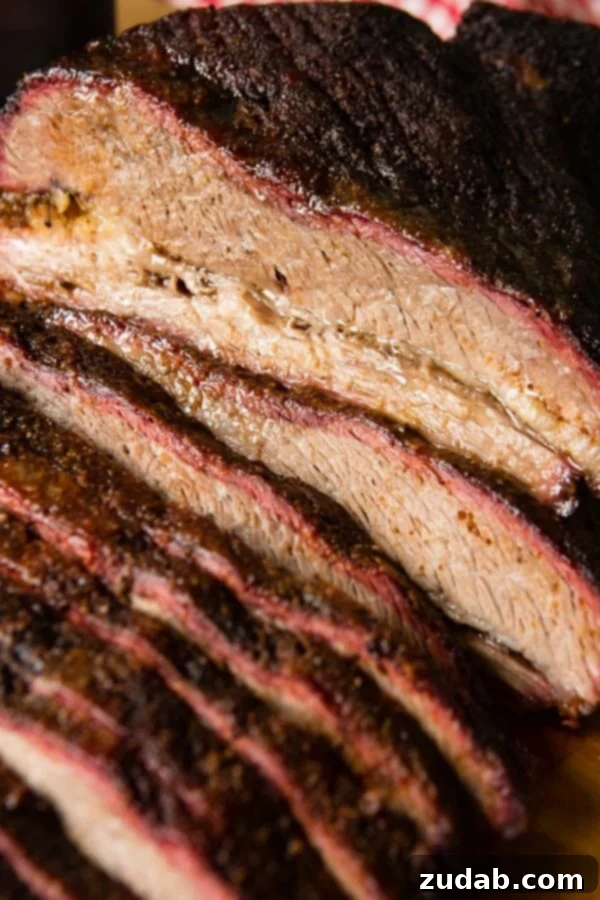
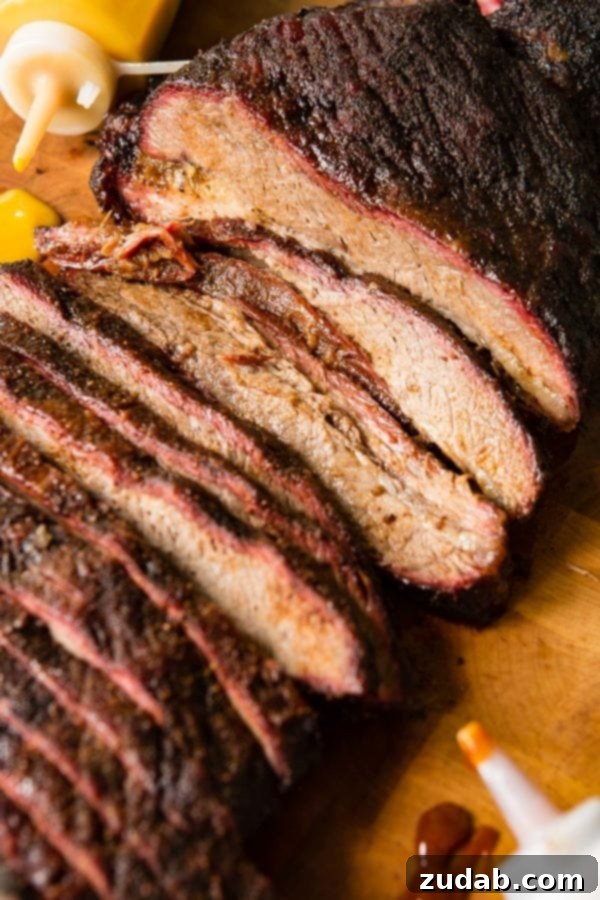
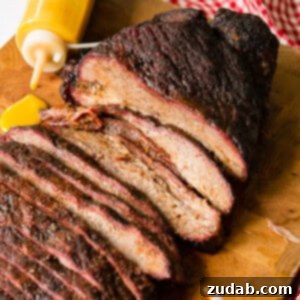
When you cut into a perfectly smoked brisket, you might notice a beautiful pink or reddish ring just beneath the outer crust (or “bark”). This visually appealing layer is known as the “smoke ring,” and it’s a hallmark of authentic low-and-slow barbecue. The smoke ring forms during the smoking process when gases from the wood smoke, primarily nitric oxide and carbon monoxide, react with the myoglobin (the protein responsible for meat’s red color) in the beef. This reaction preserves the pink hue. While a prominent smoke ring is highly sought after by BBQ enthusiasts and indicates successful smoke penetration, it’s important to remember that it is primarily an aesthetic feature. It doesn’t necessarily indicate a superior flavor or juiciness; rather, it’s a visual testament to the smoking process itself.
What is a Mop Sauce?
A “mop sauce,” also known as a basting sauce, is a thin, flavorful liquid applied to the beef during the smoking process. Typically, these sauces are apple cider vinegar or tomato juice-based, often seasoned with spices. They are usually sprayed or “mopped” onto the brisket at various intervals during the cook.
The primary purpose of a mop sauce is to help keep the surface of the beef moist, preventing it from drying out during the long smoking session. It can also contribute to the formation and flavor of the bark, adding subtle layers of taste. While some pitmasters swear by mopping, others prefer to keep the smoking process simpler, relying solely on the rub and the meat’s natural moisture. We personally like to save most of our sauce action for after the brisket is ready to eat, allowing the pure smoke flavor and bark to shine. However, don’t hesitate to experiment with mop sauces to discover what you like best. When our brisket is ready for slicing, we love to have our classic BBQ sauce on hand, along with a zesty mustard BBQ sauce for a tangy kick.
Best Cuts of Beef for Smoking Beyond Brisket
While brisket is undeniably the king of smoked beef, many other cuts from the beef family lend themselves beautifully to the low-and-slow magic of smoking. Generally, the best cuts for smoking are tougher, larger cuts with significant connective tissue or fat, as the longer, more gentle cooking time effectively melts the fat and tenderizes the beef, infusing it with incredible smoky flavor. These include:
- Brisket: The ultimate choice, as detailed in this guide.
- Ribeye Roast: A luxurious choice that benefits from smoking, resulting in a rich, beefy flavor and tender texture.
- Beef Back Ribs: These meaty ribs are fantastic when smoked, offering succulent meat that pulls easily from the bone.
- Country Style Ribs: Often cut from the chuck primal, these boneless or bone-in cuts become incredibly tender and flavorful with a long smoke.
- Chuck Roast: An economical cut perfect for shredding into pulled beef after a long smoke, similar to pulled pork.
- Short Ribs: Particularly beef plate short ribs, offer rich, fatty, and intensely beefy flavors when slow-smoked.
- Tender Cuts (for flavor infusion): Even naturally tender cuts like Tri-Tip Roast, Tenderloin Roast, or individual steaks can be briefly smoked for flavor before finishing on a grill or in an oven. This adds a beautiful smoky dimension without overcooking.
For some cuts, particularly those with less fat or desiring a specific sear, a combination cooking method works best:
Finish on Grill/In Oven: Country Style Ribs, Tri-Tip Roast, Coulotte Roast, Top Sirloin Petite Roast, Ribeye Petite Roast, Tenderloin Roast, Ground Beef Burgers, Individual Steaks (for shorter smoking times, generally 15 minutes or less, followed by a high-heat finish).
Choosing the Right Wood for Smoking Brisket
The type of wood you choose for smoking your brisket plays a significant role in the final flavor profile. Different woods impart distinct aromas and tastes, allowing you to customize your brisket to your preference. Here’s a breakdown of popular wood types and their characteristics:
- Hickory: A classic choice for beef, hickory provides a strong, sweet, savory, and robust smoky flavor. It’s one of the more popular woods due to its assertive character, perfect for those who love a deep smoke profile.
- Mesquite: This wood delivers a very intense, earthy, and bold smoky flavor. Mesquite burns hot and fast, making it excellent for cooking smaller cuts or for shorter smoking periods. Use sparingly with brisket to avoid overpowering the beef.
- Oak: One of the most common and versatile woods used for smoking. Oak offers a medium, subtle smoky flavor that is not too overpowering. It’s ideal for larger cuts like brisket, as it complements the beef without dominating it over long smoking times.
- Apple: Known for its mild, sweet, and fruity flavor. Apple wood is a great choice if you prefer a lighter smoke. It pairs wonderfully with pork but also adds a delicate sweetness to beef. It can be used by itself or mixed with a stronger wood like oak or hickory.
- Pecan: This wood provides a rich, sweet, and nutty flavor that is milder than hickory but more robust than apple. Pecan is excellent when used as a blend with other woods or by itself for a unique sweetness.
- Cherry: Offers a distinct hint of fruitiness and a beautiful reddish hue to the smoked meat. Cherry wood is versatile and can be used on its own or mixed with other woods for added complexity.
- Maple: Delivers a sweet, light, and mild smokiness to the meat. Maple is a fantastic mixing wood and also works well on its own for a subtly sweet smoke.
Experiment with different combinations to find your signature brisket flavor!
Unlock the ultimate guide to the perfect smoked beef brisket with this comprehensive resource. From meticulously selecting the right cut of meat to mastering advanced smoking techniques and perfecting the art of slicing, this guide provides everything you need to create a truly succulent, flavorful, and unforgettable brisket that will impress even the most discerning BBQ connoisseur.
More Traeger Recipes to Explore:
- Smoked Boneless Chicken Breast Recipe
- Smoked Whole Chicken Recipe
- How to Smoke a Tri Tip
- Traeger Smoked Pulled Pork
- Dry Rub Smoked Chicken Wings
- Traeger Ribs
- Glazed Smoked Chicken Wings
- Smoked Turkey Breast
- ALL OF OUR SMOKER RECIPES!
Perfect Smoked Brisket
Pin
The bold and juicy flavor of Smoked Brisket is everything! We have the perfect smoked brisket recipe that is flawless every time!
Ingredients
- 12 Pound Brisket
- 2 Tablespoons Kosher Salt, coarse
- 1 Tablespoon Black Pepper, fresh cracked
- 2 Tablespoons Dark Brown Sugar
- 2 Tablespoons Smoked Paprika
- 2 Tablespoons Granulated Garlic
- 1/3 Cup Apple Cider, or Apple Juice
Instructions
-
Remove any silver skin or excess fat from the flat end of the muscle. Trim down the large portion of fat that looks like a crescent shape. Trim any excessive or loose meat and fat from the point of the meat. See notes.
12 Pound Brisket -
Square the edges so the meat cooks more evenly. Flip the brisket over and trim the top fat cap to about 1/4″ thickness. In a mixing bowl mix the rub. Spread over the brisket.
2 Tablespoons Kosher Salt, 1 Tablespoon Black Pepper, 2 Tablespoons Dark Brown Sugar, 2 Tablespoons Smoked Paprika, 2 Tablespoons Granulated Garlic -
Preheat your smoker to 225 degrees F using super smoke and your favorite chips. Place the brisket on the smoker with the pointed end facing your main heat source. Close the lid and smoke until 165 degrees F, about 8-9 hours
-
On a large work surface, roll out a big piece of peach butcher paper and center your brisket in the middle. Spray with apple juice. Wrap the brisket. Return the wrapped brisket to the smoker, seam side down so the weight from the brisket crimps the edges of the paper wrap down tight.
1/3 Cup Apple Cider -
Close the lid on the smoker and, maintaining 225 degrees F, until the internal temperature of the brisket reaches 202 degrees F in the thickest part of the meat (takes anywhere from 3-4 hours).
-
Remove the brisket to a large cutting board and allow to rest for 2 hours before slicing. This is absolutely necessary and cannot be skipped in brisket smoking.
Recipe Notes
- Brisket fat does not melt down and make the meat juicy like pork does. Instead the fat sits and is awkward so it’s best to trim that fat away.
Left overs can be kept in the refrigerator for 4 days.
Nutrition
Nutrition information is automatically calculated, so should only be used as an approximation.
REMEMBER TO SUBSCRIBE TO our FREE Oh Sweet Basil NEWSLETTER AND RECEIVE EASY RECIPES DELIVERED INTO YOUR INBOX EVERY DAY!
When you try a recipe, please use the hashtag #ohsweetbasil on INSTAGRAM for a chance to be featured in our stories! FOLLOW OH, SWEET BASIL ON FACEBOOK | INSTAGRAM | PINTEREST | TWITTER FOR ALL OF OUR LATEST CONTENT, RECIPES AND STORIES.